

Key Points
- Mini split systems eliminate ductwork entirely — refrigerant lines connect each indoor unit directly to the outdoor condenser, removing the energy losses that make ducted systems less efficient.
- According to the U.S. Department of Energy, ductless mini splits can be 25–50% more energy efficient than traditional ducted systems — duct losses alone account for up to 30% of energy consumption in forced-air systems.
- Zone-by-zone temperature control means every room can be set independently — no more thermostat wars, and no more cooling empty rooms.
- Mini splits operate as heat pumps — a single system handles both heating and cooling, making a separate furnace unnecessary in mild climates like San Marcos.
- Whisper-quiet operation — DC motors and outdoor compressor placement make mini splits significantly quieter than window units or central air systems.
- Most ductless units include washable air filters — easier to maintain and better for allergy and asthma sufferers than ductwork that accumulates dust over time.
- Contact Comfy Air Cooling & Heating for expert mini split installation and service throughout San Marcos, TX.
When most people think of AC, they picture either window units or central air. For decades, those were the only two common choices: window units for small spaces and central air for larger homes. Mini splits changed everything.
Instead of requiring extensive ductwork, mini splits use refrigerant lines that run between each indoor unit and the outdoor condenser. Every room you want to cool or heat gets its own indoor unit and its own set of lines. Mini splits work well in both small and large spaces. They’re more expensive than window units and still require an outdoor compressor — so why are so many homeowners choosing them? Let’s take a look.
Advantage 1: They Can Save You Money and Help the Planet
Anytime air moves through ductwork, energy is lost. Ducts are never perfectly insulated, and running cold air through a hot attic wastes energy. Mini splits avoid this problem entirely. Because they don’t push air through ducts, they use less energy, and the systems themselves are smaller than traditional central air units.
Cooling accounts for around 6 percent of the average home’s energy budget. By eliminating duct losses and using a more efficient design, mini splits can lead to major savings on your utility bills while helping reduce your carbon footprint.
Why duct losses matter more than most homeowners realize:
The DOE estimates that duct losses account for up to 30% of energy consumption in a typical forced-air system. In a Texas home where the AC runs heavily from May through September, that’s a significant portion of your annual energy bill being lost before cooled air ever reaches the living space. In San Marcos specifically — where summer temperatures regularly exceed 95°F and attics can reach 130–140°F — the thermal penalty of pushing cold air through a hot attic is especially pronounced.
Mini splits also have a higher SEER (Seasonal Energy Efficiency Ratio) rating than most traditional systems, meaning they produce more cooling output per unit of energy consumed. If your current central air system is 10+ years old, upgrading to a high-SEER mini split can reduce your cooling energy costs by 30–50% or more. Learn more about AC installation and replacement options for your San Marcos home.
Advantage 2: You Can Create a More Comfortable Environment
Many families know the classic scenario: someone adjusts the thermostat by one degree, and suddenly everyone notices. With mini splits, this isn’t an issue.
Each room has its own indoor unit, allowing you to control temperatures independently. One person can keep their room cooler without freezing everyone else in the house. Mini splits are also whisper quiet, thanks to energy efficient DC motors and the placement of the compressor outdoors.
How mini split zone control works in practice:
- Individual thermostats per zone — each indoor unit has its own remote or smartphone control; household members can set their own rooms to personal preference without affecting the rest of the home
- Unoccupied room savings — turn off or raise the temperature in rooms not being used; unlike central air, which conditions the entire home regardless of occupancy, mini splits let you direct cooling only where it’s needed
- Multi-zone systems — a single outdoor condenser can serve multiple indoor units (typically 2–5 zones depending on the model), making whole-home coverage possible without ductwork
- Quiet operation numbers — most mini split indoor units operate at 19–26 decibels, roughly the sound level of a whisper; central air systems typically run at 50–70 decibels, and window units can exceed 60 decibels
This level of control is particularly valuable in San Marcos homes with mixed-use spaces — a home office, a workout room, or a converted garage — where different temperatures are needed in different areas at different times of day.
Advantage 3: Ductless Units Can Improve Air Quality
Dust buildup inside ductwork is a common problem with central air systems. Mini splits avoid this entirely. Most ductless units include washable air filters, making them easier to maintain and better for people with allergies or respiratory sensitivities.
What makes mini split air quality better than ducted systems:
- No duct contamination — central air ducts accumulate dust, mold spores, pet dander, and other allergens over years of use; without ducts, mini splits eliminate this accumulation pathway entirely
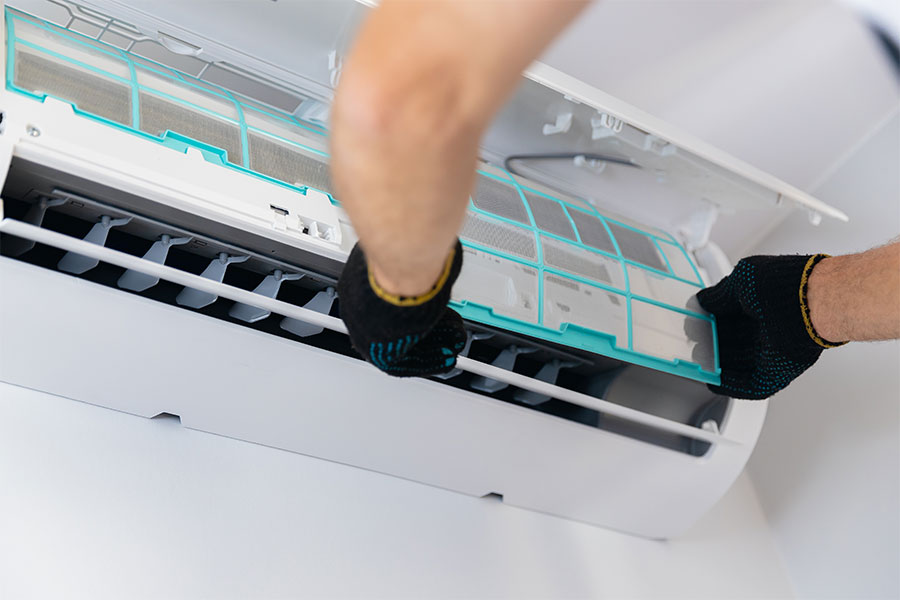
- Washable filters — most mini split indoor units have filters that slide out and rinse clean under running water, taking less than 5 minutes; this makes filter maintenance something homeowners actually do, rather than a task that gets deferred for months
- Multi-stage filtration — many modern mini split units include multiple filter layers, capturing not just dust but also bacteria, mold spores, and fine particles
- No cross-contamination between zones — each indoor unit filters and circulates air only within its own zone; allergens or particles in one room don’t get distributed throughout the home the way they can through a shared duct system
For San Marcos homeowners with family members who have allergies, asthma, or other respiratory sensitivities, the air quality difference between a mini split and a traditional ducted system can be significant. Pairing a mini split with indoor air quality services further optimizes what your system delivers.
Advantage 4: Mini Splits Offer Both Heating and Cooling
In San Marcos, we rarely need a furnace blasting on full power. In milder climates, mini splits provide more than enough heat. Why? Because they operate like heat pumps — using the same technology that cools your home but in reverse to bring heat inside.
Instead of installing both central air and a furnace, you can install a single mini split system that handles both. That’s one system to install, one system to maintain, and one system to repair when something goes wrong.
How heat pump heating works in San Marcos’s climate:
Mini splits in heat pump mode extract heat from outdoor air — even in cold weather — and transfer it indoors. This process is far more efficient than resistance heating (like electric strip heaters) because it moves heat rather than generating it. In mild climates like San Marcos, where winter temperatures rarely drop below freezing for extended periods, a mini split in heat pump mode can deliver 2–4 units of heat energy for every unit of electricity consumed — a significant efficiency advantage.
For the occasional cold snap, most modern mini splits can operate effectively down to 0°F or below. This makes them a practical year-round solution for San Marcos without the need for a separate furnace installation. If your home currently has both a central air system and a furnace, a mini split replacement can consolidate both into a single, more efficient unit.
Key Takeaways
Mini split systems offer four compelling advantages over traditional window units and central air: significant energy savings by eliminating duct losses (up to 30% of energy in forced-air systems), zone-by-zone temperature control that ends thermostat conflicts, better indoor air quality through washable filters and no duct contamination, and year-round comfort from a single system that both cools and heats. In San Marcos, Texas — where summer heat is intense and winters are mild — mini splits are particularly well-suited to local conditions. The DOE confirms ductless systems are 25–50% more efficient than traditional ducted alternatives. Contact Comfy Air Cooling & Heating for expert mini split installation and AC repair throughout San Marcos, TX.
Considering a Mini Split in San Marcos, TX?
If you’re looking for a mini split system in San Marcos, give us a call. We’re experts in ductless systems and can help you choose the right setup for your home. We also offer AC repair in San Marcos, so if you ever need service for your mini split, we’re here to help.
